
Emergency Voice Communication systems (sometimes known as disabled refuge systems) enable people waiting in a disabled refuge area to contact building responders during emergencies.
Using an Emergency Voice Communication System - installed in buildings’ disabled refuge areas, in line with Building Regulations - helps meet the requirements of the Regulatory Reform (Fire Safety) Order, which requires the safe evacuation of everyone in a building.
Why Emergency Voice Communication Systems matter
Imagine a fire breaks out in a multi-storey building. At this point, everyone in the building should have equal opportunities to exit the building safely.
However, some people may have disabilities, reduced mobility, or other accessibility requirements, that mean they require help to evacuate.
Disabled refuge systems – also known as Emergency Voice Communication Systems, or EVC systems - are important tools that support safe evacuation, by enabling anyone waiting in a disabled refuge area to quickly and reliably call for help.
Diagram 1: Benefits of Emergency Voice Communication Systems:
A disabled refuge system (Emergency Voice Communication System) can help ensure:
People in disabled refuge areas can quickly contact trained responders
Responders know exactly where help is needed
Real-time instructions and reassurance can be provided, even if mobile networks fail
Key components of an Emergency Voice Communication System
EVC systems typically include:
- Outstation: This is the item of equipment installed in the disabled refuge location. If someone’s waiting for help in that disabled refuge area, they can use the Outstation to quickly and directly contact responders, and inform them of their evacuation requirements.
- Master Station: This piece of equipment is installed in a central location that’s accessible to responders in the event of an emergency – such as a security office. Responders can use the Master Station to communicate (via the Outstation) with the person needing assistance.
Using the Emergency Voice Communication System, real-time updates can be exchanged between responders and people at Outstation locations – helping clarify important information such as:
- what the evacuation process will involve
- when help will arrive
Did you know: Some EVC systems even have an option to communicate out to numerous Outstations in a building, or even a whole complex of buildings, at once. The Refuge Alerter system, for example, can facilitate communication with up to 999 outstations.
To cable or not to cable?
Emergency Voice Communication systems tend to fall into one of two categories; Hard-wired or Radio-based.
With hard-wired systems, Outstation(s) are connected with the master station using cabling.
However, radio-based systems like Refuge Alerter can connect multiple Outstations across a building or complex without the need for new cabling to be run.
A key benefit of radio-based systems is that they are well suited to places where new cabling can't easily be installed - for example:
- Old or listed buildings
- Occupied buildings where less intrusive installation is preferred
- Large or multi-building sites.
Diagram 2: Example of a radio-based EVC system layout with multiple buildings
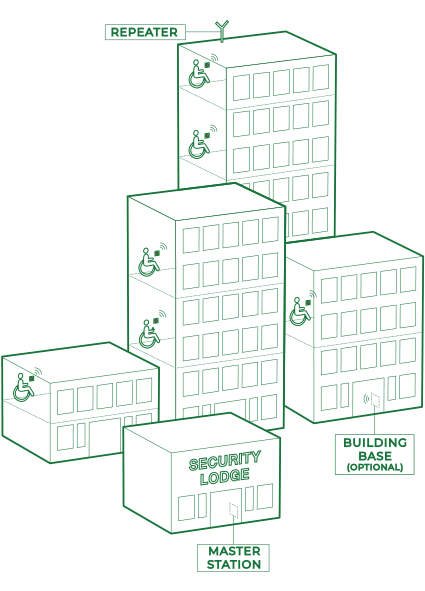
Each Refuge Alerter system uses a unique, licensed radio frequency. This means that hand-held, portable radio devices (known as Portable Refuge Communicators’ or ‘PRCs’) can also be included in Refuge Alerter systems.
PRCs enable responders to communicate ‘on the move’ with people at refuge-based Outstations. PRCs can take over communication from the Building Base station should that location become compromised.
About the author
At Alerter Group, we design and supply Emergency Voice Communication systems used across complex and occupied buildings, including radio-based solutions such as Refuge Alerter.